Extract Data from Bills of Lading Automatically
Upload any bill of lading and get shipper, consignee, cargo details, port information, and freight terms extracted as structured data in seconds.
Used by freight forwarders, customs brokers, importers, and logistics platforms worldwide.
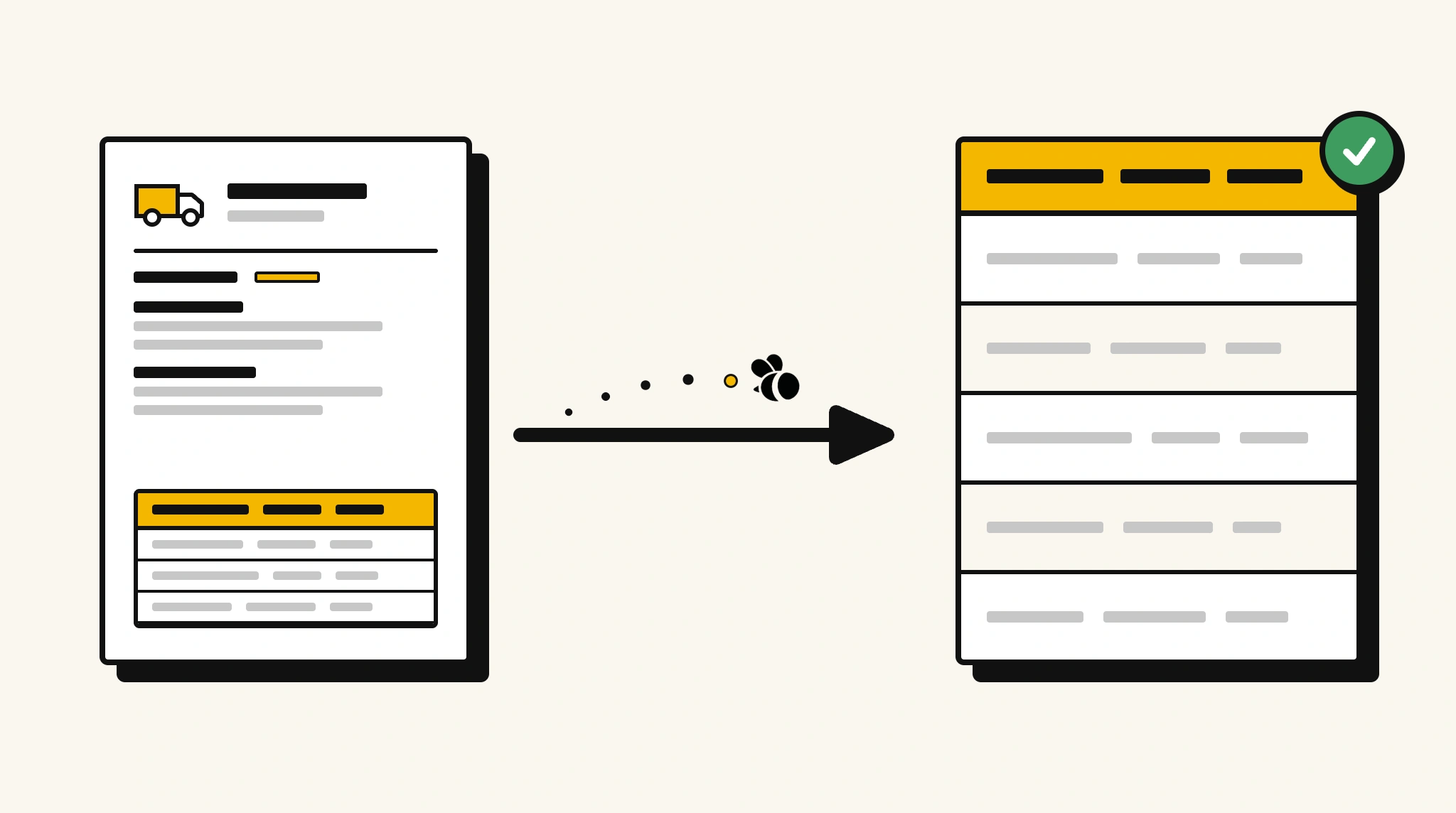
Stop manually processing bills of lading for shipment tracking
Keying shipper, consignee, and cargo details from bills of lading into freight management and customs systems is slow and creates errors that delay clearance.
❌ Before ParserBee
- Open each BOL PDF and read shipper and cargo details manually
- Re-enter consignee, port, and freight terms into your freight system
- Risk data entry errors on shipment references that cause clearance problems
- Process BOLs individually creating a backlog at high-volume ports
- Struggle to match BOLs against POs and commercial invoices
✅ After ParserBee
- Upload BOLs via browser or API as they arrive
- Extract all fields including cargo items and freight terms automatically
- Push structured data into your freight management or customs system
- Match BOL references against commercial invoices using extracted numbers
- Process shipment documents in real time, no bottlenecks
How ParserBee Parses Bill of Ladings
Three steps from document to structured data, no setup or training required.
Upload the Document
Upload a PDF, PNG, JPG, or WebP file. Multi-page documents are processed as a single job.
AI Extracts All Fields
ParserBee identifies and extracts every field automatically, no training or configuration required.
Get Structured Data
Download as JSON or CSV, or use the API to push data directly into your systems on upload.
Fields Extracted from Bill of Ladings
This extraction template comes pre-built with these fields. Add, remove, or rename any field before saving.
Sample Extracted Output
Upload a bill of lading and ParserBee returns a structured table like this, automatically.
| Field | Extracted Value |
|---|---|
| BOL Number | BOL-SYD-2025-04821 |
| Shipper | Shenzhen Industrial Exports Co Ltd |
| Consignee | Pacific Imports Pty Ltd |
| Carrier | Pacific Sealines Ltd |
| Vessel | MV Pacific Voyager |
| Port of Loading | Yantian Port, Shenzhen CN |
| Port of Discharge | Port Botany, Sydney AU |
| Shipment Date | 18 Nov 2025 |
| Expected Arrival | 05 Dec 2025 |
| Total Weight | 12,480 kg |
| Freight Charges | $4,200.00 |
| Terms | CIF, Sydney |
Every field is pulled directly from the document. You define what to extract, ParserBee does the reading.
Export Bill of Lading Data to Excel, CSV or Google Sheets
No developer needed to convert bill of ladings to Excel. Upload a whole batch in ParserBee's Data Lab, review every extracted row in a live spreadsheet, then download everything as CSV, print to PDF, or send it straight to a new Google Sheet in one click.
Prefer automation? The REST API returns clean JSON for every bill of lading, ready for Zapier, Make, n8n, or your own system.
Who Uses This Parser
Frequently Asked Questions
What data is extracted from a bill of lading?
BOL number, shipper and consignee names and addresses, carrier name, vessel or flight name, port of loading, port of discharge, shipment date, expected arrival, all cargo items, total weight, freight charges, and terms of shipment.
Does it work with sea, air, and road transport BOLs?
Yes. ParserBee works with ocean bills of lading, air waybills, and road transport waybills.
Can it extract cargo items with multiple line descriptions?
Yes. Cargo items are extracted as a repeating list with description, quantity, weight, and package type for each item.
How do I match extracted BOL data against purchase orders?
Extract the shipment reference or PO number from the BOL and match it against your open PO list using your workflow.
Can I process a batch of BOLs at once?
Yes. The batch API supports multi-document uploads for high-volume freight operations.
Related Document Parsers
Start extracting bill of lading data automatically today
Free to try. No credit card required. Works on your first upload.
Create free account