Extract Data from Customs Declarations Automatically
Upload a customs declaration form and get importer, exporter, HS codes, declared values, and duty payable extracted as structured data instantly.
Used by customs brokers, freight forwarders, and trade compliance teams worldwide.
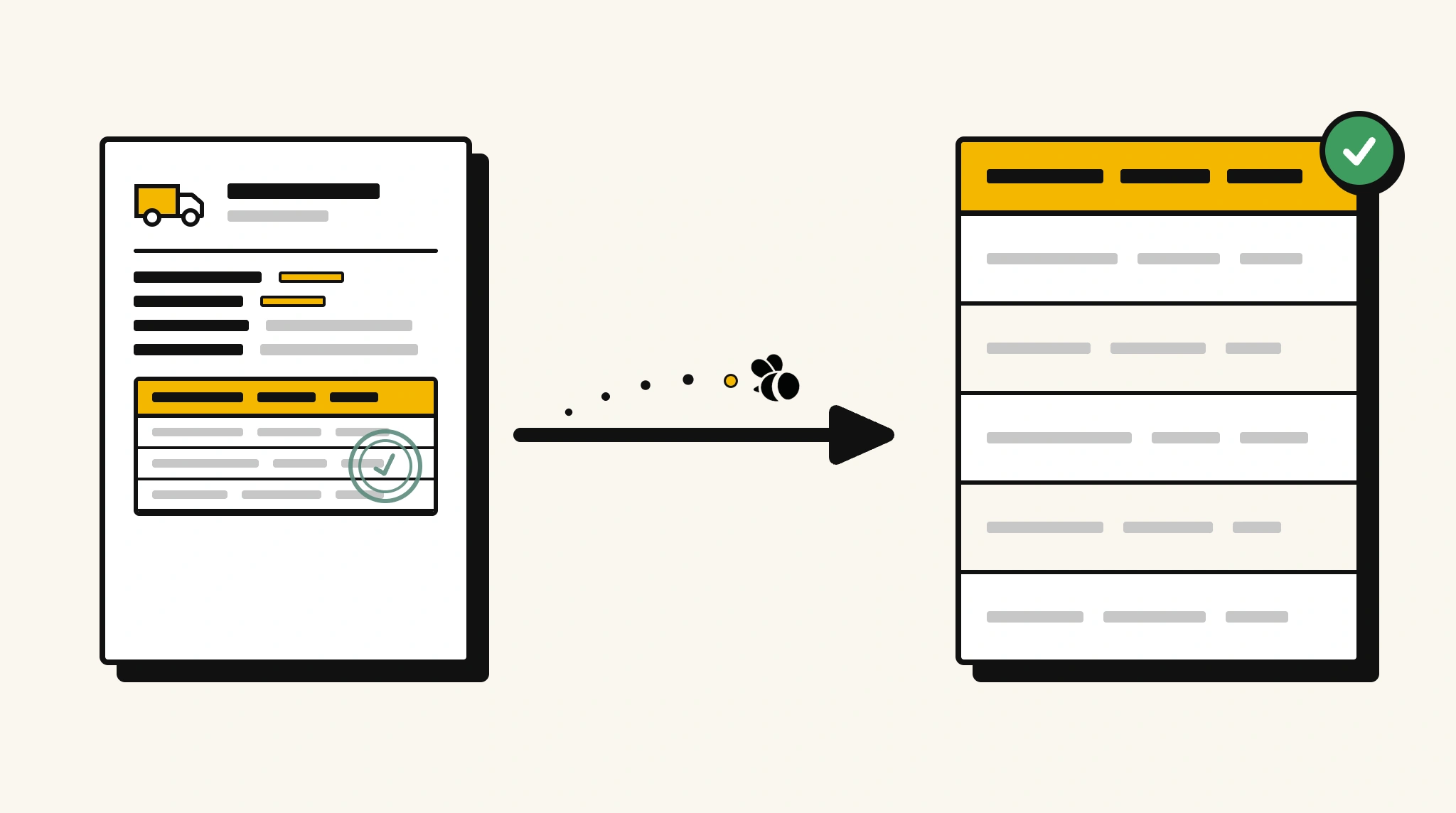
Stop manually transcribing customs declaration data
Re-entering importer details, HS codes, and declared values from customs forms into your trade compliance system is slow and risks costly compliance errors.
❌ Before ParserBee
- Read through each customs declaration to find HS codes and declared values
- Re-type commodity descriptions and duty amounts into your compliance system
- Risk transcription errors on critical tariff codes
- Process declarations from multiple countries individually
- No structured audit trail of past declarations
✅ After ParserBee
- Upload customs declarations via browser or API
- Extract importer, goods, HS codes, and duty payable automatically
- Get consistent structured data for every declaration
- Feed data into your trade compliance platform directly
- Build an auditable record of all customs filings
How ParserBee Parses Customs Declarations
Three steps from document to structured data, no setup or training required.
Upload the Document
Upload a PDF, PNG, JPG, or WebP file. Multi-page documents are processed as a single job.
AI Extracts All Fields
ParserBee identifies and extracts every field automatically, no training or configuration required.
Get Structured Data
Download as JSON or CSV, or use the API to push data directly into your systems on upload.
Fields Extracted from Customs Declarations
This extraction template comes pre-built with these fields. Add, remove, or rename any field before saving.
Sample Extracted Output
Upload a customs declaration and ParserBee returns a structured table like this, automatically.
| Field | Extracted Value |
|---|---|
| Declaration Number | CD-20251115-00234 |
| Declaration Date | 15 Nov 2025 |
| Importer | Global Imports LLC |
| Exporter | Apex Manufacturing Ltd, Shanghai |
| Country of Origin | China |
| Country of Destination | United States |
| Total Declared Value | USD 72,000 |
| Currency | USD |
| Duty Payable | USD 1,800 |
| Declarant | Pacific Customs Brokers |
Goods declared, extracted as a list
| Description | HS Code | Quantity | Declared Value |
|---|---|---|---|
| Electronic Components, Model EX200 | 8542.39.0001 | 300 cartons | USD 45,000 |
| Electronic Components, Model EX500 | 8542.39.0002 | 180 cartons | USD 27,000 |
Every field is pulled directly from the document. You define what to extract, ParserBee does the reading.
Export Customs Declaration Data to Excel, CSV or Google Sheets
No developer needed to convert customs declarations to Excel. Upload a whole batch in ParserBee's Data Lab, review every extracted row in a live spreadsheet, then download everything as CSV, print to PDF, or send it straight to a new Google Sheet in one click.
Prefer automation? The REST API returns clean JSON for every customs declaration, ready for Zapier, Make, n8n, or your own system. See all integrations.
Who Uses This Parser
Frequently Asked Questions
What data is extracted from a customs declaration?
Declaration number and date, importer and exporter names, country of origin, export, and destination, goods description with HS code, quantity, and declared value per line, total declared value, currency, duty payable, and declarant name.
Can it extract HS codes accurately?
Yes. HS codes are extracted as structured fields per goods line item. The AI reads multi-digit tariff codes reliably from standard customs forms.
Does it work with customs forms from different countries?
Yes. ParserBee adapts to customs declaration formats from any country. Customize field descriptions to match local form requirements.
Can it handle declarations with multiple commodity lines?
Yes. Goods are extracted as a repeating list. Each line captures description, HS code, quantity, and declared value.
How do I use extracted data in my compliance system?
Use the API to receive structured data and map it to your trade compliance or customs management platform.
Related Document Parsers
Start automating customs declaration extraction today
Free to try. No credit card required. Works on your first upload.
Create free account